Stop the January Drop: Why Selling Your Car in November Saves You Thousands
At the turn of the new calendar year on January 1, vehicles instantly experience an accelerated drop in resale value as industry valuation guides automatically reclassify them as a full model year older. To explain why selling in November locks in maximum trade-in value before year-end depreciation hits, we spoke with Derek Gainey, Customer Relations Manager at Ken Ganley Buying Center Boardman, who brings 28 years of automotive experience to help vehicle owners make informed financial timing decisions.
Q: How much value does a vehicle lose at the turn of the new calendar year?
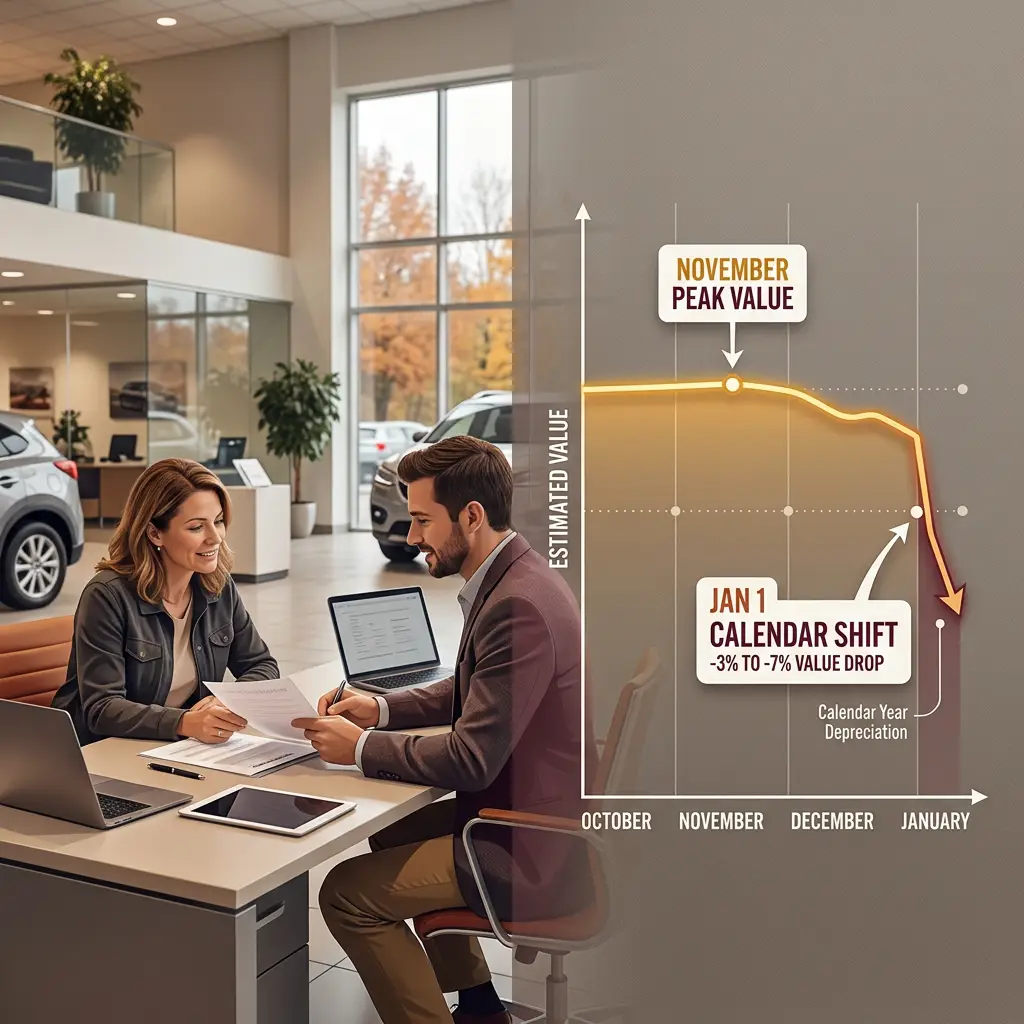
A: Vehicles instantly lose value on January 1 because major appraisal frameworks like Black Book and Kelley Blue Book automatically re-index vehicle ages by a full calendar year on that date. Even if a vehicle has not accumulated a single additional mile between December 31 and January 1, market valuation software recalculates its residual baseline as an older model year. This paper depreciation typically causes an immediate resale loss of 3% to 7% overnight, on top of normal monthly mileage wear.
When vehicle owners wait until January or February, they absorb that calendar shift directly out of their equity. Selling in November captures peak value while the vehicle still maintains its current calendar-year classification on paper. If you want to check where your car currently stands before the year-end transition, you can find our Boardman showroom directions to drop by for a physical assessment, or give our appraisal desk a call at (330) 427-3656 to discuss your mileage and vehicle condition.
Q: Derek, how does the arrival of new model year inventory in autumn impact used vehicle pricing?
A: Autumn arrivals of current and next model year inventory create immediate downward pricing pressure on older pre-owned models across every vehicle segment. As manufacturers ship fresh inventory to dealer lots during late summer and autumn, older models experience accelerated depreciation because shoppers naturally compare pre-owned prices directly against newly incentivized models. By November, wholesale auction supplies adjust to absorb these late-year trade-ins, which gradually softens wholesale clearing prices.
Selling during November allows vehicle owners to get ahead of the full market reaction before wholesale prices cool further in mid-winter. Dealerships actively look for clean pre-owned vehicles during this window to maintain balanced lot choices for holiday buyers. You can explore our pre-owned vehicle selection to see how current market pricing reflects model-year transitions across various trim levels and body styles.
Q: Does a vehicle's fuel economy change the financial case for selling it in November?
A: A vehicle's fuel efficiency significantly alters its trade-in trajectory late in the year, with high-efficiency models holding value much better during market shifts than fuel-thirsty alternatives. Recent wholesale index reports show that vehicles rated at 40 mpg or better gained nearly 10% in value over the course of the year, whereas vehicles averaging under 15 mpg dropped roughly 15% over the same period. This creates a 25-point valuation gap driven almost entirely by pump prices and daily running costs.
For drivers completing suburban errands around Boardman Township, high-efficiency compacts and hybrid crossovers maintain exceptional trade-in leverage right through November. Conversely, if you own a larger gas-powered SUV or truck that gets lower gas mileage, selling in November prevents further value erosion before winter fuel demands and seasonal shifts impact market sentiment.
Q: Why is November considered a favorable month to sell or trade in a vehicle?
A: November represents a sweet spot for selling because dealership demand for quality pre-owned inventory peaks right before holiday shopping period and winter weather slowdowns. Dealerships are actively filling their lots to meet year-end retail sales targets and accommodate buyers looking to complete vehicle purchases before tax season. At the same time, retail buyers who want to upgrade before winter travel create a steady stream of showroom traffic throughout the month.
"Vehicles take an automatic age hit on January first regardless of actual mileage, making November the prime window to capture peak trade-in value."
By taking action in November, sellers capitalize on strong wholesale demand while avoiding the foot-traffic lulls typical of late December and January. Vehicle owners can easily evaluate their options by choosing to sell or trade your vehicle online to receive an accurate, real-time estimate based on current market condition factors.
Q: Are trade-in values higher in November than in January?
A: Trade-in values are historically higher in November than in January because vehicles retain a younger model-year status on paper and overall market buyer traffic is noticeably stronger. Once January arrives, consumer foot traffic drops due to post-holiday budget tightening and severe winter weather, while wholesale auctions adjust baseline values downward for the new calendar year.
For daily commuters taking I-680 out of Youngstown, waiting until January often means navigating winter slush only to receive a lower appraisal valuation due to mandatory calendar depreciation. Selling in November eliminates that extra month of winter road exposure and locks in top-tier trade-in equity when buyer demand remains steady.
Q: Which vehicle categories experience the highest demand boost in November?
A: All-wheel-drive crossovers, midsize SUVs, full-size pickup trucks, and fuel-efficient commuter cars experience the most pronounced demand surge during November. As winter weather approaches across northern regions, buyers actively search for vehicles equipped with all-wheel drive, enhanced ground clearance, and winter capability features like heated seats and defrost packages.
Compact and midsize SUVs with proven safety ratings and solid fuel efficiency ratings are especially sought after by families preparing for holiday road trips. Because these specific categories sell quickly during late autumn, appraisers are often willing to offer strong trade-in values for clean, well-maintained examples in November.
Q: Why do dealers push for higher trade-in volume before the end of November?
A: Dealerships push for higher pre-owned trade-in volume in November to hit annual sales performance goals and build high-quality inventory ahead of the winter buying season. Manufacturer year-end volume programs often feature significant financial benchmarks for dealerships, creating strong incentive to acquire inventory and complete transactions before December closing deadlines.
In my daily conversations on the lot, vehicle owners often ask why we push so hard for inventory before December, and it comes down to meeting factory volume targets while giving shoppers fresh pre-owned options before winter. Acquiring trade-ins directly from local owners allows dealerships to bypass high auction fees and offer better valuation terms to sellers.
Q: What are the holding costs of waiting until spring instead of selling in November?
A: Holding a vehicle from November through spring incurs substantial carrying costs that erode thousands of dollars in potential equity through insurance premiums, registration fees, maintenance costs, and calendar depreciation. Over a four-month delay, an owner continues paying monthly comprehensive insurance and vehicle registration costs on a car that sits idle or accumulates extra winter mileage.
Furthermore, winter driving subjects body panels, brake components, and exhaust systems to road salt and chemical de-icers, which can cause undercarriage oxidation and cosmetic surface rust. Combined with the automatic model-year age drop on January 1, these combined holding expenses almost always outweigh any hypothetical spring price rebound.
Q: Should you replace worn tires before selling your car in November, and how do you get started?
A: Replacing worn tires is only necessary if the tread depth has dropped below 4/32 inches, as appraisers must factor immediate safety reconditioning costs into the final trade offer. If your tires have adequate tread remaining, spending hundreds of dollars on a brand-new set rarely yields a one-to-one return on your trade-in appraisal. In most cases, it is far more cost-effective to let the buying center handle tire replacements using wholesale inventory pricing.
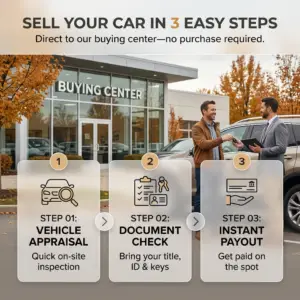
Getting started with selling your car in November is straightforward and stress-free. Gather your vehicle title or current payoff statement, balance registration documents, and visit our Boardman buying center for a rapid, transparent appraisal. You can also reach out directly to our team by calling (330) 427-3656 to schedule a convenient appointment and secure your vehicle's value before the new year arrives.
While every effort has been made to ensure the accuracy of the information displayed on this website, the vehicle values, offers, and listings shown may not reflect all accurate vehicle details or current market conditions. Vehicle photos may be representative only and may not match the actual vehicle. All offers, appraisals, and transactions are subject to vehicle inspection, verification, and prior sale. Final purchase amounts may vary based on condition, equipment, history, and market factors. Please contact the Dealership for complete details and confirmation.