Beat Negative Equity: Proven Hacks to Sell Your Car Without Losing Money
Does Paying Off Negative Equity With a Credit Card Make Financial Sense?
Paying off negative equity with a credit card rarely makes financial sense because standard credit card interest rates far exceed auto loan interest rates. The only situation where this strategy functions effectively is when you utilize a 0% APR promotional balance transfer credit card and have a guaranteed plan to clear the balance before the promotional rate expires. According to consumer finance guidance from the Consumer Financial Protection Bureau, transferring auto debt into high-interest revolving credit generally increases your total cost of ownership and overall debt burden.
When vehicle owners attempt to put a loan shortfall on a standard credit card, credit card processing fees often get added to the transaction. Most vehicle purchasing operations and financial institutions pass credit card merchant fees along to the customer, adding another percentage to your balance. Shifting secured debt—which is backed by a vehicle asset—into unsecured revolving credit can also negatively alter your credit utilization ratio, potentially lowering your credit score.
If you are evaluating options for handling an existing auto loan balance, stopping by our Boardman buying center allows our team to review your vehicle's current market value and structure a clear transaction. You can also give our team a quick call to walk through your current loan balance and explore the most cost-effective path forward.
Table of Contents
- What Does It Mean to Have an Upside-Down Loan and How Is Negative Equity Calculated?
- Where and How Do You Request an Official Loan Payoff Amount?
- How Can You Sell a Financed Car Outright to a Boardman Buying Center?
- How Does a Private Sale Work When Your Vehicle Has a Lender Lien?
- How Does Rolling Negative Equity Into a New Car Loan Work?
- What Ohio Title Steps Must You Complete After Paying the Negative-Equity Shortfall?
What Does It Mean to Have an Upside-Down Loan and How Is Negative Equity Calculated?
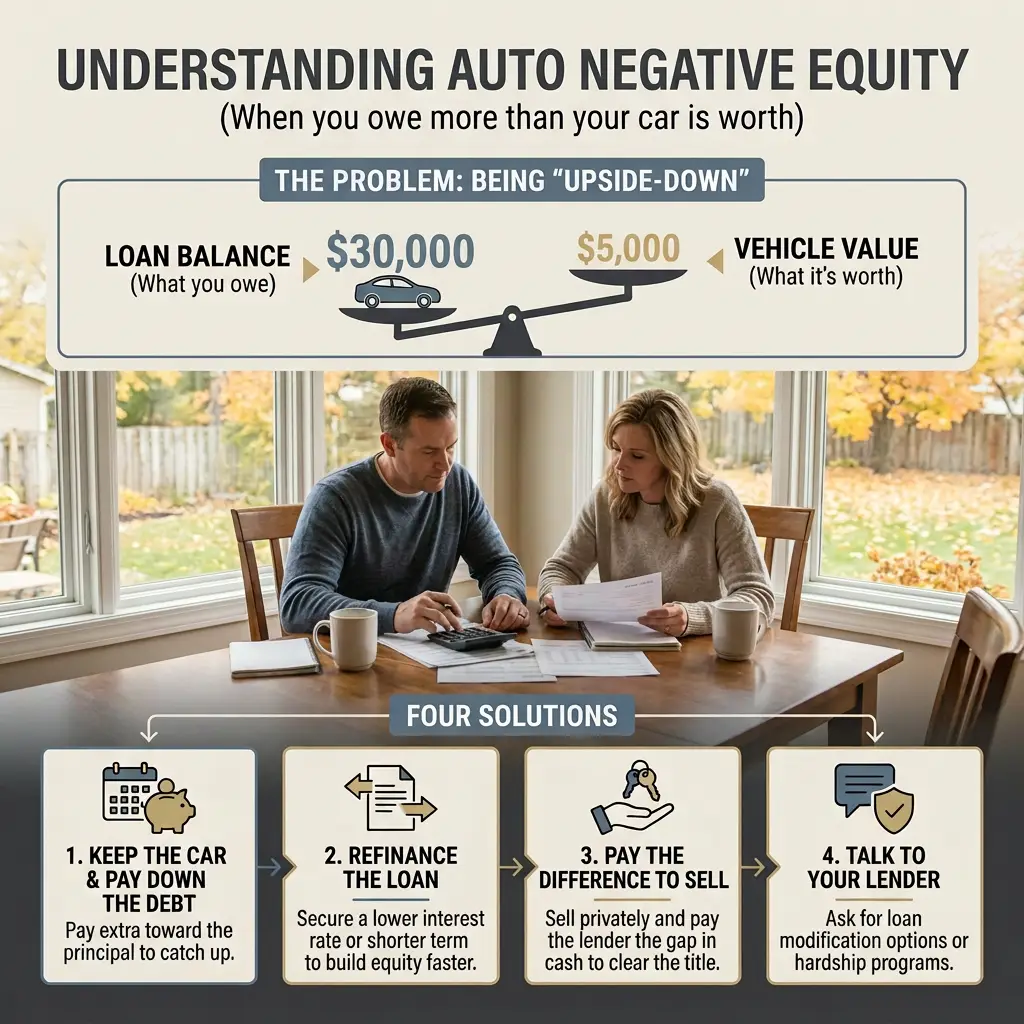
An upside-down loan occurs when the remaining loan principal on your vehicle contract exceeds the car's current fair market value, creating a financial condition known as negative equity. Calculating negative equity requires taking your official 10-day loan payoff figure from your lending institution and subtracting the current cash value offer or trade-in appraisal of your vehicle. For instance, if your lender requires ten thousand dollars to satisfy the loan completely, but a market evaluation values the car at eight thousand dollars, you have two thousand dollars in negative equity.
Vehicles frequently enter an upside-down status due to initial depreciation rates, extended loan terms beyond 60 months, low initial down payments, or rolling debt over from a previous auto loan. During the first few years of vehicle ownership, standard depreciation reduces market value faster than standard loan payments reduce the underlying principal. This gap widens even further if the original purchase included financed add-on products or high interest rates that slow principal reduction.
Understanding your vehicle's actual market value helps prevent unpleasant surprises when you decide to change vehicles. Comparing current valuation figures against your remaining balance gives you a clear baseline of your position. Exploring pre-owned vehicle inventory values across the regional market provides realistic expectations for what similar models are fetching in current market conditions.
Where and How Do You Request an Official Loan Payoff Amount?
You request an official loan payoff quote directly from your primary auto lender through their online customer portal, mobile application, or customer service telephone division. Unlike a basic monthly account balance statement, an official loan payoff quote calculates the exact principal plus accrued daily interest through a specific future date, typically valid for 10 calendar days.
When requesting your 10-day loan payoff statement, ensure you ask the financial institution for their specific lien payoff instructions, including the physical mailing address for overnight checks, electronic wire details, and account numbers. Lenders also need to specify whether they require a certified check or direct bank transfer when closing out an active lien account. Having this document in hand gives you precise financial data before structuring any sale or vehicle exchange.
It is critical to note that daily interest continues to accrue until the full payment posts to your account. If a payment settlement arrives past the specified expiration date, a small residual interest balance may remain on your account. Obtaining an updated payoff letter directly from the lienholder prevents delays when clearing the title.
How Can You Sell a Financed Car Outright to a Boardman Buying Center?
Selling a financed vehicle outright to a professional buying center involves receiving a physical cash appraisal, securing your official loan payoff quote, and paying any remaining balance shortfall directly to complete the sale. When you bring your vehicle to our team, we conduct an on-site vehicle inspection to establish its current market value. If our cash offer is less than your total loan balance, you pay the negative equity difference directly to us, and our finance department handles the full payoff payment to your lender to release the lien.
Many vehicle owners prefer selling directly to a dedicated acquisition facility rather than navigating private sales. Commuters driving along Market Street in Boardman Township appreciate avoiding the safety risks, non-paying buyers, and tedious paperwork of private listings. Our team manages all communications with your bank, issues the funds directly to satisfy your loan, and ensures the title transfer complies fully with state rules.
For sellers seeking a hassle-free transaction, review our detailed guide on selling your car outright in Ohio to understand how quick direct purchasing can be. When evaluating your sale, comparing selling to a local buying center versus a national chain highlights the advantages of working with localized specialists who understand local market values and handle loan payoffs efficiently.
How Does a Private Sale Work When Your Vehicle Has a Lender Lien?
Executing a private sale on a vehicle with an active lender lien requires coordinating payment arrangements between the private buyer, your financial institution, and yourself. Because the bank holds the legal title until the underlying debt is satisfied, a private buyer cannot immediately take ownership of a clear title at the time of payment. To handle this safely, both parties usually meet at a physical branch of the seller’s financial institution to submit payment, satisfy the payoff amount, and initiate the lien release process.
If the sale price does not cover the full payoff amount, you as the seller must provide certified funds to cover the negative equity shortfall during the transaction. Once the bank receives full payment, they release the lien electronically or mail the physical paper title directly to the seller or buyer, depending on state regulations and lender policies. This processing period can take anywhere from a few business days to several weeks.
Private buyers are often hesitant to hand over funds without receiving a physical title on the spot. Clear communication, written bill-of-sale agreements, and conducting the transaction directly inside a bank branch help build trust and ensure the buyer's payment goes directly toward clearing the existing debt.
How Does Rolling Negative Equity Into a New Car Loan Work?
Rolling negative equity into a new vehicle contract transfers your remaining unpaid loan balance onto the principal balance of a new car loan. If you owe three thousand dollars more on your current vehicle than its trade-in value, that three-thousand-dollar balance gets added to the purchase price of the replacement vehicle. This increases the total amount financed, raising your monthly loan payment and total interest charges across the duration of the new finance contract.
While rolling debt allows you to transition into a replacement vehicle without paying out-of-pocket cash today, it immediately places your new loan in an upside-down position. Financing previous vehicle debt alongside a new asset's initial depreciation compounds negative equity, making it harder to reach positive equity down the road.
Lenders also set maximum loan-to-value limits on new financing contracts. If the combined total of the new vehicle price, options, taxes, and rolled-over negative equity exceeds the lender's loan-to-value threshold, the loan application may require a cash down payment to qualify for approval.
What Ohio Title Steps Must You Complete After Paying the Negative-Equity Shortfall?
Completing an Ohio title transfer after clearing a negative-equity shortfall requires receiving a formal lien release from your lender and properly signing the assignment section of the title before an authorized official. Under Ohio law, the seller must sign the physical title assignment in the presence of a notary public or a deputy clerk at a County Clerk of Courts title office. Commuters traveling into Youngstown to finalize paperwork must ensure the purchase price, buyer information, and exact odometer reading are filled out accurately prior to notarization.
Once your lender settles the remaining balance and releases the lien, confirm whether your title was issued electronically or as a physical paper document. If Ohio holds an electronic title for your vehicle, the lien cancellation posts to the Ohio Bureau of Motor Vehicles system, allowing a paper title to be printed at any county clerk title office. After signing over ownership, Ohio Revised Code requires you to remove your license plates from the vehicle immediately, as registration does not transfer to the buyer.
If you have questions about clearing an active lien or navigating Ohio title assignment paperwork, visiting our physical location at 7871 Market St, Boardman, OH 44512 gives you direct access to experienced vehicle acquisition specialists. You can also start the conversation by giving us a call at (330) 427-3656 to discuss your loan balance, schedule an in-person vehicle valuation, and discover how easy clearing your auto loan debt can be.
© 2026 Ken Ganley Buying Center Boardman. All rights reserved.
While every effort has been made to ensure the accuracy of the information displayed on this website, the vehicle values, offers, and listings shown may not reflect all accurate vehicle details or current market conditions. Vehicle photos may be representative only and may not match the actual vehicle. All offers, appraisals, and transactions are subject to vehicle inspection, verification, and prior sale. Final purchase amounts may vary based on condition, equipment, history, and market factors. Please contact the Dealership for complete details and confirmation.