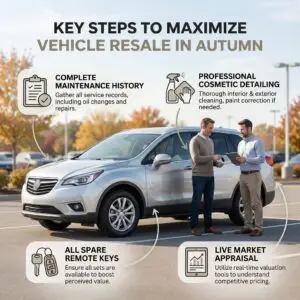
What I Tell Customers About Selling a Car in October
Is October a Good Month to Sell Your Car in Boardman?
October is a strong month to sell a car in Boardman Township, particularly if you own a crossover, truck, or all-wheel drive vehicle. Upcoming winter weather creates immediate local buyer demand for winter-capable transportation before snow hits the Mahoning Valley. While overall market trade-in values tend to ease slightly across late autumn compared to spring tax-refund months, strong regional demand for reliable foul-weather vehicles keeps autumn trade-in values competitive.
When drivers ask me if holding onto an SUV until November makes sense, I usually point out how early cold snaps shift buyer demand fast in northeastern Ohio. Drivers shopping for family transport or reliable daily transportation want winter-ready capability before temperature drops begin. Vehicles equipped with high ground clearance, heated seating, and modern safety technology attract elevated buyer attention throughout October.
Selling in mid-autumn also allows you to capitalize on your car's current mileage and condition before severe winter weather hits. Driving through another season of snow, road salt, and freezing temperatures adds wear to tires, brakes, and undercarriage components. Taking care of your transaction now locks in current valuation before winter driving adds additional mileage or potential cosmetic stress to your vehicle. If you are ready to evaluate your options, you can reach out directly by giving us (330) 427-3656 or visiting our Boardman showroom location to discuss a direct appraisal.
Table of Contents
- Should You Sell Your Car in Autumn or Wait Until Spring in the Midwest?
- Do Truck and SUV Values Peak in Fall Compared to Sports Cars?
- What Used-Car Market Conditions Impact an October Appraisal?
- How to Sell or Trade Your Vehicle and Complete the Title Transfer
Should You Sell Your Car in Autumn or Wait Until Spring in the Midwest?
Selling in autumn makes financial sense if you drive a winter-ready truck or SUV, while waiting until spring favors sports cars, convertibles, and rear-wheel-drive models. Spring brings a surge in overall market buyer activity powered by federal tax refund checks, but waiting through winter subjects a vehicle to roughly 1.5 percent to 3 percent in additional seasonal depreciation, alongside six months of added age, mileage, and winter salt exposure.
Deciding between a fall or spring sale comes down to balancing holding costs against seasonal buyer trends. Keeping a car parked through the winter months incurs ongoing expenses including insurance coverage, monthly loan payments, and garage space allocation. Furthermore, severe freezing cycles can impact battery performance and fluid health if the vehicle sits idle for extended periods.
If your primary goal is avoiding additional winter depreciation and eliminating ongoing carrying costs, completing your sale in October delivers clean execution. You avoid tire replacements, unexpected cold-weather maintenance, and the seasonal value drop that affects most daily drivers as they cross into a new calendar year.
Do Truck and SUV Values Peak in Fall Compared to Sports Cars?
Truck and SUV values experience peak regional buyer interest during fall and early winter in snow-prone northern states, whereas sports car and convertible valuations peak between April and June. Buyers actively seek 4WD powertrains and high ground clearance ahead of winter road conditions, causing pre-winter trade-in offers on trucks to hold firm while sports car demand drops off significantly until warmer weather returns.
In urban areas like Youngstown, daily commuters frequently seek out sturdy crossovers with advanced traction control systems to navigate icy hills and slushy morning commutes. Compact sedans and two-wheel-drive coupes see lighter seasonal demand during this window because buyers prioritize winter traction over fuel economy or sporty styling.
Understanding this seasonal split helps you price and position your vehicle accurately. Owners of open-air convertibles or rear-wheel performance cars generally see lower cash offers in October unless the vehicle is priced aggressively. Conversely, owners of three-row family crossovers or midsize pickups will find October to be one of the most advantageous market windows of the entire year. To explore how regional preferences impact vehicle offers, take a look at our breakdown on comparing national online car buyers with local buying centers.
What Used-Car Market Conditions Impact an October Appraisal?
An October appraisal is driven by restricted national used-vehicle inventory levels and tight local supply for affordable commuter vehicles. Inventory data shows the national average listed price for used cars reached $27,239 in late summer, with vehicles priced below $15,000 sitting at just a 29-day supply nationwide. That broader inventory tightness helps support vehicle valuations entering the fourth quarter.
Fourth-quarter inventory trends also shift as dealerships receive new model-year shipments. As trade-ins from new-car buyers enter dealership lots, overall used inventory increases, which can create minor downward pressure on late-model sedan pricing. However, because production disruptions from previous years limited overall vehicle manufacturing volumes, high-quality pre-owned vehicles remain in consistent demand across all price brackets.
To get the most accurate picture of your car's market value, focus on localized supply and demand rather than broad national estimates. Comparing recent sales of similar years, trims, and mileage figures provides realistic expectations for your appraisal offer.
How to Sell or Trade Your Vehicle and Complete the Title Transfer
Selling a vehicle in Ohio requires a notarized seller signature on the title assignment before legal ownership can transfer to a buyer. Completing the sale through a licensed vehicle buying center simplifies this process because on-site notary staff can authenticate the title assignment immediately, clear remaining loan liens, and issue funds in a single visit without requiring multiple notary appointments.
Private-party vehicle sales require coordinating paperwork with third-party notary publics, verifying buyer funds, and managing state title transfers independently. Any discrepancy or error in filling out the legal title block can delay the transaction or require a duplicate title filing through the county clerk of courts. Working directly with an established buying center eliminates those administrative delays.
Our team handles every step of the paperwork, including loan payoffs, state title transfers, and official notarization on the spot. You can review our step-by-step car selling guide for detailed transaction advice. When you are ready to complete your sale or trade, stop by our physical location at 7871 Market St, Boardman, OH 44512 or give us a quick call at (330) 427-3656 to schedule your quick on-site vehicle appraisal.
© 2026 Ken Ganley Buying Center Boardman. All rights reserved.
While every effort has been made to ensure the accuracy of the information displayed on this website, the vehicle values, offers, and listings shown may not reflect all accurate vehicle details or current market conditions. Vehicle photos may be representative only and may not match the actual vehicle. All offers, appraisals, and transactions are subject to vehicle inspection, verification, and prior sale. Final purchase amounts may vary based on condition, equipment, history, and market factors. Please contact the Dealership for complete details and confirmation.