How to Ensure You Are Getting the Best Deal When Selling Your Car
How Do You Ensure You Are Getting the Best Deal When Selling Your Car?
To ensure you get the absolute best deal when selling your vehicle, you must establish a data-backed market baseline using local transactional guidebooks, gather multiple competitive written cash offers, and account for sales tax savings if you plan to replace the car. Securing top dollar requires presenting a clean vehicle with documented maintenance records, verifying title transfer requirements, and selecting a buyer capable of providing immediate payment without unexpected reconditioning deductions.
Over my 28 years as a Customer Relations Manager, I have walked thousands of car owners through the appraisal and selling process. Getting maximum value for your vehicle comes down to preparation and market knowledge rather than high-pressure negotiation. Many sellers make the mistake of relying on a single online valuation quote without realizing that used vehicle prices shift weekly based on regional supply, consumer demand, and physical inspection findings. When you understand how professional appraisers evaluate your car, you gain complete control over the transaction.
A crucial part of maximizing your payout is recognizing the operational differences between various selling methods. Selling privately might show a higher theoretical asking price on paper, but it requires advertising out of pocket, hosting test drives with strangers, and navigating complex lien payoffs on your own. Conversely, working with a dedicated buying center provides immediate funding, handles official title transfers, and eliminates administrative risk. If you want to discuss your vehicle’s current standing or speak directly with our appraisal team, feel free to give us a quick call or stop by our Boardman showroom location to review your options in person.
The suburban driving environment around Boardman Township involves a steady mix of heavy stop-and-go commercial traffic along Market Street and regular highway trips across the region. Because local drivers rely heavily on dependable transportation for daily errands and commuting, well-maintained vehicles with strong fuel economy, working all-wheel drive, and up-to-date safety features command premium attention on our lot. Presenting your vehicle with complete service documentation proves to buyers that it handled these daily driving demands without deferred maintenance.
Table of Contents
- How Do I Determine the True Market Value of My Car Before Selling?
- How Do Kelley Blue Book, Edmunds, and NADA Valuation Tools Differ?
- How Much Does Cosmetic Condition and Detailing Affect a Car’s Sale Price?
- Is It Worth Paying for Professional Paint Correction or Dent Repair Before Selling?
- What Is the Real Financial Difference Between Trading In and Selling Privately?
- How Can Multiple Appraisals Confirm Your Cash Offer Is Truly Competitive?
- What Papers and Steps Are Needed to Finalize Your Vehicle Sale Efficiently?
- Why Selling Your Vehicle to Ken Ganley Buying Center helps deliver strong value
How Do I Determine the True Market Value of My Car Before Selling?
Determining your car’s true market value requires cross-referencing recent regional sales transactions for your exact year, trim level, and mileage band rather than relying on a single static website estimate. True market value represents the precise dollar figure active buyers are paying in your local geographic area right now, adjusted for physical vehicle condition, accident history, and factory options.
To build an accurate valuation picture, start by gathering your vehicle identification number, exact odometer reading, and a list of installed factory features. Industry data highlights how strongly age and mileage govern baseline value bands. For example, national market reporting from Edmunds shows that the average pre-owned car sold in the $10,000 to $15,000 price range was roughly 9 years old with an average odometer reading of 98,222 miles. Understanding where your car sits relative to typical annual usage—generally accepted as 12,000 to 15,000 miles per year—helps you anticipate whether an appraiser will classify your mileage as low, average, or high.
Another major factor in determining value is timing and seasonal shifts in consumer demand. Market data from Edmunds shows that three-year-old pre-owned vehicles averaged $31,548 during the first quarter of 2026 before rising to $32,461 in the second quarter. These quarterly swings illustrate why static guidebooks often lag behind real-time market conditions. Evaluating active retail listings gives you a clear snapshot of what shoppers are paying today, while reviewing trade-in guides shows what buyers pay wholesale. For a deeper breakdown of valuation tools, take time to learn about understanding why online Blue Book values vary during real-world appraisals.
In my experience, sellers who research active pre-owned inventory before requesting appraisals achieve far more predictable outcomes. Browse our current quality used inventory to see how comparable vehicles with similar option packages and mileage figures are priced on the retail market. When you compare your vehicle against live retail listings, remember that retail prices include reconditioning costs, safety inspections, dealer warranties, and inventory holding expenses that separate wholesale cash offers from retail lot prices.
How Do Kelley Blue Book, Edmunds, and NADA Valuation Tools Differ?
Kelley Blue Book, Edmunds, and NADA valuation tools serve completely different functions because each draws from distinct transaction datasets across retail, consumer, and wholesale markets. Kelley Blue Book focuses heavily on consumer retail transactions and dealer auction data, Edmunds relies on a proprietary market algorithm centered on localized dealer sales, and NADA focuses primarily on wholesale auction figures and financial institution lending limits.
Understanding these underlying data sources explains why the numbers generated by each tool rarely match. Kelley Blue Book divides its valuations into distinct categories, including trade-in range, private party value, and suggested retail price. These values are updated weekly using actual sales transactions and auction figures adjusted for regional economic trends across more than 100 geographic areas. Because KBB is widely recognized by consumers, it serves as a helpful baseline, though its online algorithms cannot physically inspect your car’s mechanical condition or paint depth.
Edmunds utilizes a pricing system known as True Market Value, which calculates what buyers are currently paying for similar vehicles in specific regional zones. Edmunds weighs dealer sales data heavily, making it particularly useful for gauging retail vehicle pricing. On the other hand, NADA values—now managed by J.D. Power—are heavily favored by credit unions, banks, and automotive insurers. NADA guides emphasize clean wholesale value and clean retail value, which directly influence the maximum loan amount a lender will approve for a buyer financing that specific vehicle.
When comparing valuation tools, keep in mind that online estimates are starting points rather than binding checkbooks. National aggregators use broad statistical averages that may not account for regional demand spikes for specific body styles or drive configurations. Reviewing our resource on comparing national online buyers to local buying centers shows how a physical buying center evaluates real-time regional demand, factory package desirability, and actual vehicle presentation to deliver an immediate, actionable offer.
How Much Does Cosmetic Condition and Detailing Affect a Car’s Sale Price?
A comprehensive interior and exterior detailing job directly impacts your car’s final sale price by elevating its physical appraisal tier from fair to good or very good. Investing in a professional deep clean, paint decontamination, and interior reconditioning typically adds $500 to $1,500 to a vehicle’s total valuation by removing visual flaws that appraisers treat as mechanical red flags.
Vehicle appraisers categorize cars into strict condition tiers: excellent, very good, good, and fair. Less than 5 percent of pre-owned vehicles qualify as excellent because that rating requires flawless original paint, zero interior wear, and pristine mechanical components. The vast majority of daily-driven vehicles fall into the fair or good categories. When a car arrives covered in road grime, salt residue, pet hair, or food stains, appraisers naturally assume that routine mechanical maintenance was similarly neglected, leading to conservative offers designed to cover hidden reconditioning costs.
When vehicle owners ask how much professional detailing actually moves the needle on their offer, I show them how moving a car from fair to good on our physical appraisal sheet instantly increases its market payout. A proper detail addresses critical touchpoints that shape first impressions, including:
- Exterior paint decontamination using a clay bar and iron remover to eliminate embedded road grime, industrial fallout, and surface roughness.
- Interior cabin restoration involving hot-water carpet extraction, leather conditioning, and thorough cleaning of high-touch surfaces like the steering wheel, gear shifter, and infotainment screens.
- Engine bay cleaning to wipe down valve covers, fluid reservoirs, and heat shields, signaling that the engine has been leak-free and properly serviced.
- Wheel and tire dressing to remove baked-on brake dust from alloy rims and restore natural rubber luster.
Spacious family vehicles with generous cargo capacity and multi-row seating frequently accumulate heavy cabin wear from soccer gear, grocery bags, and family road trips. Taking time to deep-clean carpet fibers, vacuum rear cargo wells, and treat seat upholstery prevents appraisers from deducting hundreds of dollars for interior reconditioning. A fresh, clean cabin reassures the buyer that the car was cared for throughout its lifespan.
Is It Worth Paying for Professional Paint Correction or Dent Repair Before Selling?
Spending $100 to $300 on targeted paint touch-ups or paintless dent repair delivers a positive return on investment whenever it eliminates noticeable visual defects that would otherwise drop your vehicle’s appraisal condition rating. Minor cosmetic repairs are worth performing when the repair cost is significantly lower than the appraisal deduction an appraiser will apply for visible body damage.
Paintless dent repair is one of the most cost-effective cosmetic fixes available to sellers. Technicians use specialized tools to massage minor door dings and hail spots out of body panels from behind, preserving the original factory paint finish without requiring expensive body filler or respraying. Because a single visible dent can downgrade a vehicle from good condition to fair condition—costing $500 to $1,000 in lost trade-in value—paying $150 to fix that ding nets a clear financial gain.
Major paint correction and body shop repairs require a more cautious financial calculation. Single-stage paint polishing or applying factory touch-up paint to minor stone chips on the front bumper is economical and preserves curb appeal. However, spending $1,500 to respray a rear bumper cover or repair deep quarter-panel damage rarely yields a dollar-for-dollar return at trade-in. Professional buyers and dealerships possess in-house reconditioning teams that perform body repairs at wholesale cost, meaning an appraiser will deduct far less for minor damage than a retail consumer would pay a body shop to fix it.
Before spending money on body shop quotes, request an initial inspection from a professional buyer. An experienced appraiser can review your vehicle’s exterior in minutes and tell you directly whether fixing a scratch or crease will increase your net offer or simply waste your out-of-pocket cash. Focusing strictly on low-cost, high-impact touch-ups ensures you keep more money in your pocket when the sale closes.
What Is the Real Financial Difference Between Trading In and Selling Privately?
The real financial gap between selling privately and trading in at a dealership narrows significantly once you account for state sales tax credit allowances, advertising costs, and potential loan payoff complications. While a private party listing may display an asking price 10 to 15 percent higher than a wholesale trade-in quote, net proceeds after expenses and tax adjustments are often remarkably similar.
In Ohio, selling or trading your car involves specific state tax regulations governed by the Ohio Bureau of Motor Vehicles. When you trade in a vehicle toward the purchase of another car at an authorized dealership, state law allows you to apply the trade-in value directly against the purchase price of the new or pre-owned vehicle. You only pay state and county sales tax on the remaining net difference. For instance, if you purchase a vehicle for $30,000 and trade in your current car for $15,000, you pay sales tax solely on the $15,000 balance, saving hundreds of dollars in tax liability depending on your county residence.
Selling a vehicle privately eliminates this built-in tax advantage while introducing several operational costs and personal safety responsibilities. Private sellers must manage the following tasks independently, including:
- Out-of-pocket marketing expenses for online listing fees, classified placements, and vehicle history report purchases.
- Safety and screening requirements for vetting unknown buyers, organizing public test drives, and verifying certified bank funds.
- Lien payoff administration when an active auto loan exists, requiring coordination between your lender, the buyer’s bank, and the state title office.
- Post-sale liability management to ensure the buyer immediately registers the vehicle and releases you from future traffic violations or toll charges.
Residents in the urban neighborhoods of Youngstown who commute daily across the Mahoning Valley often value the speed and legal certainty of a direct dealer sale over the extended effort of a private listing. Managing test drives and negotiating price drops with private buyers during a busy work week can stretch over several weeks. A direct cash sale or trade-in resolves your transaction in a single appointment, delivers verified funds instantly, and completes all required state paperwork on the spot.
How Can Multiple Appraisals Confirm Your Cash Offer Is Truly Competitive?
Comparing written cash quotes from multiple appraisal sources provides the exact leverage needed to verify whether a dealer trade-in offer reflects current competitive market rates. Collecting two or three physical or digital cash offers establishes a firm floor for your vehicle’s value, ensuring you never accept a lowball offer out of convenience.
To conduct a true apples-to-apples appraisal comparison, provide every potential buyer with identical, accurate vehicle details. Ensure that your vehicle’s VIN, exact option packages, trim designation, tire condition, and physical flaw disclosures match across every appraisal request. Inconsistent condition disclosures during online appraisals are the single largest cause of post-inspection offer revisions, so complete transparency up front guarantees that your written quotes remain firm when you present the vehicle for final payment.
When evaluating competing quotes, review the fine print accompanying each cash offer. Some online buying services issue preliminary estimates that are subject to mandatory reconditioning fee deductions, administrative processing charges, or transport deductions upon delivery. A truly competitive offer is a transparent, binding check or electronic wire transfer for the exact amount printed on the appraisal sheet, backed by a clear guarantee period that gives you time to make an informed decision without high-pressure sales tactics.
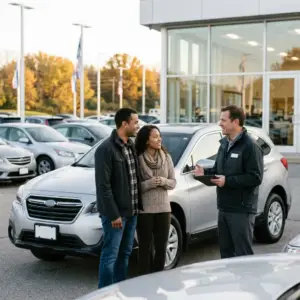
A local buying center offers a major advantage during the appraisal comparison process because physical appraisers evaluate local market trends directly. If a regional shortage exists for clean crossovers equipped with advanced safety technology like lane-keeping assist, blind-spot monitoring, or adaptive cruise control, a local buyer can adjust your cash offer upward to secure that inventory for local drivers. Relying on physical local appraisals ensures your offer reflects local buyer demand rather than generic national averages.
What Papers and Steps Are Needed to Finalize Your Vehicle Sale Efficiently?
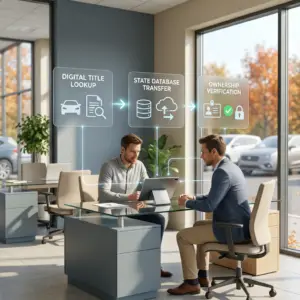
Finalizing a vehicle sale cleanly requires an original certificate of title, an accurate odometer disclosure statement, and a signed release of liability. Having your ownership paperwork organized prior to accepting an offer prevents payment delays, legal disputes, and administrative backlogs at the Bureau of Motor Vehicles.
The original vehicle title is the single most critical document in any automotive transaction. Under Ohio law, the seller must sign the title over to the purchaser, disclosing the exact odometer reading at the time of transfer. If a lienholder is named on the front of your title because of an active auto loan, you must obtain a formal lien release from your financial institution or bring your lender’s official payoff statement to the buyer so the balance can be settled directly from the sale proceeds.
Gathering the following supporting paperwork streamlines your sale and builds buyer confidence:
- Comprehensive maintenance logs detailing oil change intervals, brake service receipts, tire rotations, and multi-point inspection reports.
- Factory owner’s manuals and all original sets of ignition keys, remote key fobs, or valet keys.
- Current vehicle registration card to verify owner identity and address against your state-issued photo ID.
- Official lien payoff quote printed on lender letterhead, detailing the exact daily payoff amount and mailing address for funds.
Once payment is verified and the title is assigned, immediately remove your license plates from the vehicle before turning over the keys. In Ohio, license plates remain with the seller and can be transferred to another vehicle or returned to the BMV. Submitting an official notice of sale or release of liability protects you from future parking tickets, red-light camera citations, or towing fees incurred by the new owner before their registration is finalized.
Why Selling Your Vehicle to Ken Ganley Buying Center helps deliver strong value
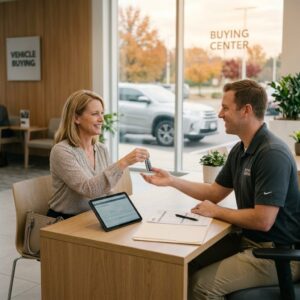
At Ken Ganley Buying Center Boardman, we eliminate the friction, waiting, and valuation guesswork by turning your vehicle’s real-time market appraisal into an immediate, binding cash offer. We buy any make and model regardless of age or mileage, delivering transparent cash payouts backed by our team’s extensive local automotive experience.
Our appraisal process is built around complete clarity and convenience for local car owners. When you bring your vehicle to our dedicated buying center, our physical appraisal team conducts a thorough, fair evaluation right in front of you. We explain how your car’s options, mileage, and physical condition factor into our valuation, cross-referencing live market sales data to ensure you receive a competitive payout. You avoid the safety risks of hosting private test drives, paying for advertising, or waiting weeks for private buyers to secure bank financing.
If you still owe money on your current vehicle loan or are approaching the end of a lease, our team handles all administrative details on your behalf. We contact your lender directly to process the loan payoff, submit the required state odometer disclosures, and issue you a check or electronic payment for your equity on the spot. If your loan balance exceeds the vehicle’s market value, we walk you through flexible options to settle the difference seamlessly.
Getting top value for your car should be straightforward, fast, and stress-free. Visit our local buying center home page to start your online value estimate, or stop by our location at 7871 Market St, Boardman, OH 44512 for a quick in-person evaluation. You can also connect with our team directly by calling (330) 427-3656 to turn your car into cash payment today.
© 2026 Ken Ganley Buying Center Boardman. All rights reserved.
While every effort has been made to ensure the accuracy of the information displayed on this website, the vehicle values, offers, and listings shown may not reflect all accurate vehicle details or current market conditions. Vehicle photos may be representative only and may not match the actual vehicle. All offers, appraisals, and transactions are subject to vehicle inspection, verification, and prior sale. Final purchase amounts may vary based on condition, equipment, history, and market factors. Please contact the Dealership for complete details and confirmation.