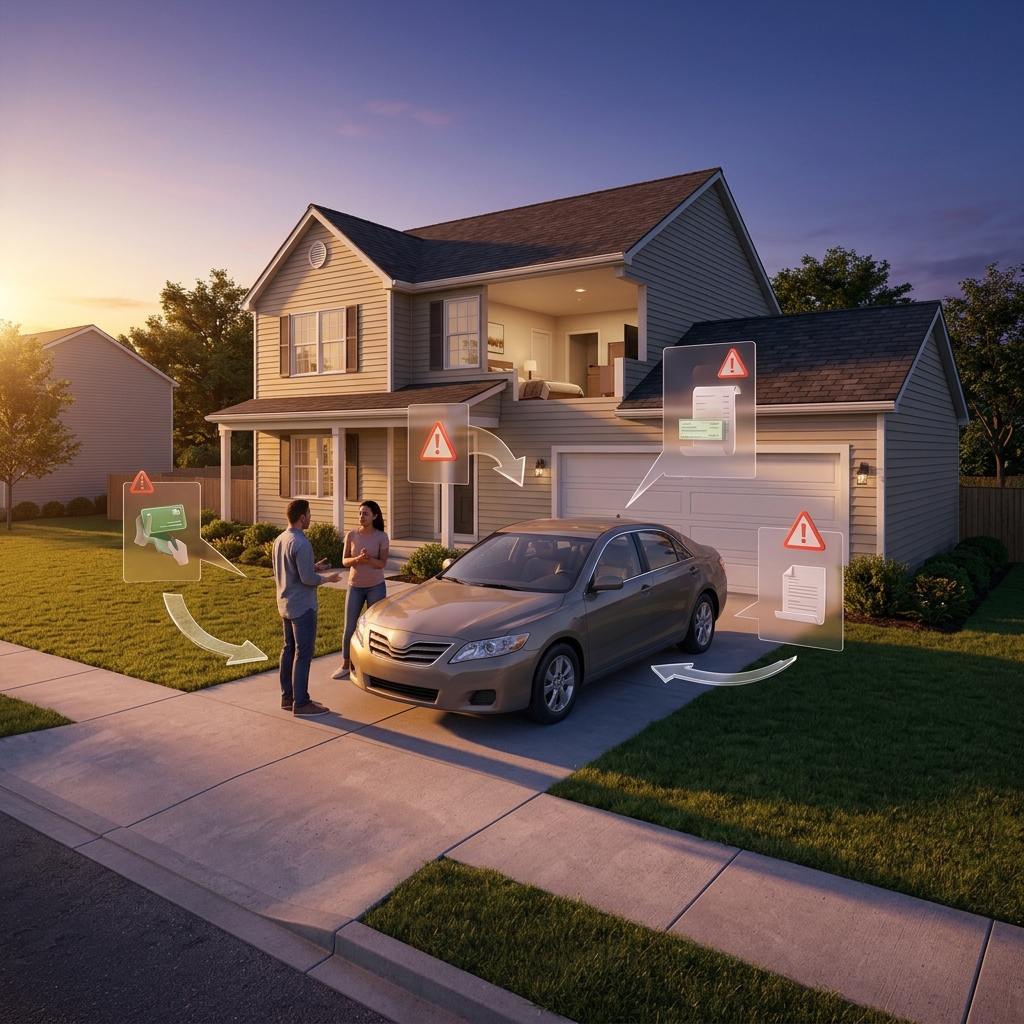
Selling a vehicle privately exposes owners to payment fraud, physical security threats during test drives, and post-sale legal liabilities. Financial losses often occur through forged cashier’s checks, fake electronic money transfers, or overpayment refund schemes. Additionally, if the title transfer or Ohio notary requirements are incomplete, the seller remains legally liable for traffic violations, accidents, and financial claims involving the vehicle after physical handover.
When vehicle owners attempt to sell privately, they assume all operational responsibilities typically managed by professional buyers. Screening potential buyers requires sharing contact information and arranging meetings with strangers. Furthermore, accommodating test drives carries the risk of property damage or theft, particularly if a prospective buyer drives aggressively or lacks active auto insurance.
Navigating the financial and legal aspects of a private sale also creates significant friction. Verifying funds can take days or weeks, leaving sellers uncertain whether a transaction is truly complete. Incomplete bill of sale documentation or improper odometer disclosures can result in administrative delays at state title offices. Choosing a direct, professional transaction at our Boardman location eliminates these security gaps entirely. Sellers can also give our team a quick call to learn how an immediate valuation provides reliable funds without private marketplace hazards.
Table of Contents
- What Are the Most Common Payment Scams in Private Car Sales?
- What Safety Risks and Legal Liabilities Do Private Sellers Face?
- What Questions Do Sellers Ask About Avoiding Private Car Sale Risks?
- How Can You Skip Private Sale Hazards by Selling Directly to Ken Ganley Buying Center?
What Are the Most Common Payment Scams in Private Car Sales?
The most common payment scams in private vehicle sales involve fraudulent cashier’s checks, cancelled peer to peer app transfers, and overpayment refund schemes. Fraudsters rely on processing delays at financial institutions, tricking sellers into surrendering keys before the payment bounces.
Counterfeit cashier’s checks represent one of the most frequent traps for private sellers. These documents are crafted to mimic legitimate bank drafts, complete with realistic watermarks and routing numbers. Bank tellers may initially deposit the draft, granting temporary credit to the account. However, when the issuing bank officially rejects the instrument days later, the financial institution rescinds the funds, leaving the seller without both the vehicle and the money.
Overpayment schemes build upon this check fraud strategy. In this scenario, a buyer sends a check or electronic draft for an amount higher than the agreed sales price, citing an administrative error or shipping fee requirement. The buyer then instructs the seller to wire back the surplus funds immediately. Once the seller remits the cash, the original check fails clearance, resulting in substantial out-of-pocket losses.
Peer-to-peer mobile payment applications also present distinct vulnerabilities. Fraudulent buyers often use stolen credit card details or hacked accounts to send money. Once the rightful account holder reports the unauthorized activity, the payment service reverses the transfer. Other scammers generate fake transaction confirmation screens to convince sellers that funds are en route. To prevent these scenarios, sellers should independently verify cashier’s checks by looking up bank branch phone numbers directly rather than using contact information printed on the check.
Sellers planning to trade their current vehicle while upgrading can explore our selection of quality pre-owned vehicles to secure guaranteed funds and transparent vehicle history reports in a single, secure environment.
What Safety Risks and Legal Liabilities Do Private Sellers Face?
Private vehicle sellers face significant safety risks during test drives and serious legal liability if title paperwork is improperly filed. Allowing strangers into a personal vehicle creates physical theft risks, while delayed title transfers keep the seller legally linked to subsequent accidents, parking tickets, and impound fees.
Meeting prospective buyers in unfamiliar locations introduces personal safety hazards. Fraudulent buyers may use fake profiles or stolen identities to schedule meetups, creating opportunities for robbery or vehicle theft during a test drive. Additionally, a seller’s primary auto insurance policy generally remains responsible for damages if a prospective buyer causes a collision during a test drive. Boardman Township commuters navigating busy corridors along Market Street understand how unexpected traffic conditions can quickly complicate an unfamiliar driver’s test route.
Legal exposure extends well beyond the physical exchange of keys. Under state regulations, the seller’s signature on the certificate of title must be signed before an official notary. Buyers are legally required to complete the title transfer at a County Clerk of Courts title office within 30 days of purchase. In Ohio, title fees are set at $18, and buyers must pay a base state sales tax of 5.75 percent along with any local county tax additions. If a private buyer delays or skips this official registration process, the seller remains the legal owner of record.
When a vehicle remains registered in the seller’s name, subsequent traffic citations, automated toll charges, and impound storage bills are mailed directly to the seller’s home. If the unrecorded owner is involved in a severe crash, injured parties may direct lawsuits toward the registered owner. Vehicle owners can learn how to sell a vehicle safely and compare national buyers with local buying centers to protect themselves against long-term legal complications.
What Questions Do Sellers Ask About Avoiding Private Car Sale Risks?
Sellers frequently seek practical ways to verify payment legitimacy, prevent test drive incidents, and protect themselves against post-sale liabilities. Addressing these specific concerns helps owners decide whether a private transaction justifies the associated effort and financial risk.
Reviewing answers to common buyer and seller scenarios helps clarify the transaction process before listing a vehicle. Vehicle owners can also examine our full collection of frequently asked questions for additional insights into trade appraisals and vehicle purchasing steps.
Q: What should a seller do if a buyer attempts an overpayment refund scam?
Immediately halt all communication and refuse to proceed with the sale. An overpayment proposal is a clear indicator of financial fraud designed to extract liquid funds before a fraudulent check or draft is discovered by your bank. Never wire funds, purchase gift cards, or send digital payments back to a buyer. If you have already deposited a suspicious check, inform your bank’s fraud department right away.
Q: What is the biggest danger in a private vehicle sale?
Unrecoverable payment fraud represents the single largest hazard in a private vehicle transaction. Scammers deploy sophisticated fake cashier’s checks, forged bank wires, or reversible app transfers to secure both the vehicle and the signed title. Once the seller hands over physical possession, recovering the stolen vehicle or reversing the bank chargeback proves extremely difficult, resulting in complete financial loss.
Q: How can a seller verify that a cashier’s check is authentic?
Verify the check by contacting the issuing bank directly using a verified telephone number obtained from the financial institution’s official website. Do not call the phone number printed on the check, as scammers frequently insert fake contact details. For maximum security, complete the transaction in person inside a local branch of the issuing bank, allowing a teller to verify available funds and issue cash or a verified internal transfer.
Q: Can a seller be held liable if a buyer crashes during a test drive?
Yes, because private auto insurance policies typically follow the vehicle rather than the individual driver. If a prospective buyer causes an accident during a test drive, the seller’s insurance policy serves as the primary coverage for property damage and medical claims. This exposure can result in expensive deductible payments, policy cancellations, or increased future insurance premiums.
Q: What happens if a private buyer fails to transfer the title after purchase?
The seller remains listed as the official legal owner on state administrative records. Consequently, any parking fines, red-light camera violations, toll charges, or municipal impound fees incurred by the new driver will be billed to the seller. Furthermore, if the vehicle is involved in a hit-and-run or criminal activity, law enforcement agencies will contact the registered seller first.
How Can You Skip Private Sale Hazards by Selling Directly to Ken Ganley Buying Center?
Selling directly to Ken Ganley Buying Center Boardman helps reduce payment risks, stranger interactions, and title transfer delays. Our professional team provides immediate payment, handles all official notary and clerk paperwork on-site, and helps reduce post-sale liability through a straightforward process.
We Want to Buy Your Car — Any Make, Any Model, Payment available after final offer. Vehicle owners in Canfield traveling along local routes can avoid the hassle of listing ads, screening unknown callers, and arranging parking lot meetings. Whether your vehicle is fully paid off or has an outstanding lien with a lender, our appraisal specialists streamline the transaction, contact your lienholder directly for payoff balances, and issue verified funds on the spot.
By choosing a trusted local buying center, you receive an offer based on current market data based on current live wholesale data without waiting weeks for private buyers to secure financing. Stop by our Boardman location today, call our team directly at (330) 427-3656, or explore our main vehicle buying center portal to get a current cash offer from our team.
© 2026 Ken Ganley Buying Center Boardman. All rights reserved.
While every effort has been made to ensure the accuracy of the information displayed on this website, the vehicle values, offers, and listings shown may not reflect all accurate vehicle details or current market conditions. Vehicle photos may be representative only and may not match the actual vehicle. All offers, appraisals, and transactions are subject to vehicle inspection, verification, and prior sale. Final purchase amounts may vary based on condition, equipment, history, and market factors. Please contact the Dealership for complete details and confirmation.