Why Right Now Might Be the Perfect Time to Sell Your Car
As a General Manager here at Ken Ganley Buying Center Boardman with over 10 years of experience, I spend a lot of time watching the market shift and helping families navigate the best time to move on from their current vehicle. One of the first things I tell people who visit us at 7871 Market St, Boardman, OH 44512 is that the “perfect” time to sell is often a mix of market data and your own personal needs. Right now, we are seeing a very unique window where used car values remain significantly higher than historical averages, even as the extreme peaks of the last few years begin to level out.
Let’s talk about the current landscape. According to recent wholesale used-vehicle price data, values have cooled by about 12% year over year as of early 2026. While that sounds like a drop, you have to remember where we started; prices are still well above 2019 levels. For many drivers in Youngstown, this means the car sitting in your driveway might still be worth thousands more than you’d expect based on traditional depreciation curves. If you are curious about what your specific year and model could bring, you can easily start the process online to see where you stand.
I often hear from folks who are worried they missed the boat on high trade-in values. While it’s true we aren’t in the “wild west” era of 2022 anymore, the supply of late-model, low-mileage vehicles is still relatively tight. If you’re ready to upgrade or simply want to downsize your household fleet, I recommend giving our team a quick call to discuss your options. You can also find our Boardman location easily if you prefer to have a face-to-face conversation about the market.
How to Track Whether Your Car’s Value is Trending Up or Down
Many of our customers ask me how they can tell if they should sell today or wait a few months. In my experience, the best way to handle this is to treat your car like a financial investment. I suggest checking online appraisal tools every few weeks to see if the trade-in or private-party estimates are moving. If you see a consistent downward trend over a month or two, it usually signals that local inventory is catching up with demand, and waiting longer might cost you money.
Working with families across the Mahoning Valley, I’ve noticed that mileage thresholds and vehicle condition play a massive role in these trends. For example, a car that crosses the 100,000-mile mark often sees a sharper dip in value than one at 90,000 miles. Similarly, a vehicle with a clean accident history and documented maintenance will always hold its value better during market shifts. We take pride in our transparency, and you can see what other local drivers have to say by reading our latest customer feedback.
Another factor to watch is the time of year. We typically see used vehicle demand strengthen during the late winter and early spring, often fueled by tax refund season. If you notice that local lots are looking empty, that’s usually a sign that your car is in high demand. On the flip side, when new model years arrive in the late fall, older models often see a slight softening in price. Keeping an eye on these small details can help you squeeze every bit of value out of your trade-in.
Table of Contents
- The Reality of Used Car Prices and Post-Pandemic Market Shifts
- Understanding the Financial Gap Between Trade-In and Private Party Value
- How the Ohio Sales Tax Credit Maximizes Your Vehicle Trade-In Value
- Comparing Depreciation Rates of Used EVs Versus Gasoline Vehicles
- How to Successfully Sell or Trade a Car with an Active Loan Balance
The Reality of Used Car Prices and Post-Pandemic Market Shifts
One thing I always tell customers is that the “new normal” for car prices is here to stay. While average used-vehicle transaction prices peaked a couple of years ago, they haven’t crashed back to where they were before 2020. This is largely because new car MSRPs have risen, which keeps the floor for used car pricing higher than it used to be. For a professional commuting into Downtown Youngstown, this means your current vehicle is a more powerful asset than it would have been five years ago.
I often see shoppers surprised by how much late-model vehicles still command. Even though new car production has normalized, the “lost years” of low production during the pandemic created a permanent gap in the supply of three-to-five-year-old cars. This scarcity keeps values high for the exact types of reliable, fuel-efficient SUVs and sedans that local families are looking for. If you want to stay updated on these market shifts, I invite you to check out our latest market insights where we break down these trends in detail.
It is also important to consider the impact of open safety recalls. Data from the NHTSA shows that vehicles with up-to-date recall repairs are much easier to sell and often command a better price. Before you decide to sell, ensuring those quick fixes are handled makes your car much more attractive to a buyer. This kind of preparation, combined with the current market’s elevated baseline, creates a strong selling environment for those with well-maintained vehicles.
Understanding the Financial Gap Between Trade-In and Private Party Value
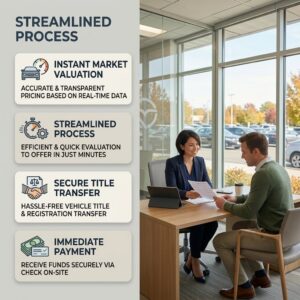
I often get asked about why there is a difference between what a dealer offers and what you see on a listing site. The truth is that trade-in value is typically about 10% to 15% lower than a private-party sale price. This gap exists because a professional buying center handles the reconditioning, the marketing, and the legal liability of the sale. When you sell to us, we take on the risk and the work, providing you with a check the same day.
From my perspective, the real value of a trade-in isn’t just the number on the page—it’s the time and safety you save. Selling a car privately often involves meeting strangers, dealing with potential financing hurdles, and handling complex paperwork. If you have questions about how we calculate our offers, our frequently asked questions page covers the details of the appraisal process. We aim to make the transition as smooth as possible, especially for busy families who don’t have weeks to spend managing a private sale.
Another thing to consider is the “all-in” cost. When you sell privately, you might get a higher gross number, but you also have to factor in the cost of any repairs needed to make the car sellable, detailing fees, and the value of your own time. At a buying center, we buy cars in “as-is” condition, which often nets you a similar “clean” profit without the headache. It’s about finding the balance that fits your lifestyle and your budget.
How the Ohio Sales Tax Credit Maximizes Your Vehicle Trade-In Value
Here is something I always remind my customers in Ohio: the sales tax credit can actually bridge the gap between a trade-in offer and a private sale. In our state, when you trade in a vehicle toward the purchase of another one, you only pay sales tax on the difference between the two prices. For example, if you are buying a vehicle for $30,000 (example price) and your trade-in is worth $15,000, you only pay tax on the remaining $15,000.
This tax savings can amount to hundreds or even thousands of dollars, depending on your local tax rate. When you add that savings back into the trade-in offer, the “real-world” value of trading in often meets or exceeds what you would have walked away with after a private sale. If you’re planning your next move, I encourage you to reach out to our team so we can run the numbers for you and show you exactly how much you can save.
This benefit is a major reason why many residents in Moon Township and surrounding areas choose to trade in rather than sell privately. It simplifies the math and keeps more money in your pocket for the features that matter, like advanced safety technology or all-wheel drive for our Ohio winters. It’s a practical, straightforward way to make your next vehicle more affordable while taking advantage of your current car’s high market value.
Comparing Depreciation Rates of Used EVs Versus Gasoline Vehicles
Now, when it comes to the electric vehicle market, the rules are a little different right now. We have seen that many used EVs are experiencing faster depreciation than traditional gasoline-powered cars. This is partly due to the rapid advancement in battery technology and frequent price adjustments on new electric models. If you own an older EV with a shorter range, its value might be more sensitive to market shifts than a comparable gas-powered SUV.
I find that buyers are often more cautious with used EVs because of concerns about battery longevity and out-of-warranty repair costs. This means that if you are looking to sell an electric vehicle, doing so while it still has a significant portion of its manufacturer warranty remaining is crucial. Gasoline vehicles, on the other hand, tend to follow a more predictable and slower depreciation curve because the technology is more mature and the secondary market is much larger.
Despite these differences, a well-maintained EV with a documented service history and a healthy battery report can still find a great home. The key is understanding that the market for these vehicles moves quickly. If you’re driving an EV and thinking about a change, staying ahead of the curve and selling while the technology is still current is usually the smartest financial move.
How to Successfully Sell or Trade a Car with an Active Loan Balance
Let me explain how we handle vehicles that still have an active loan. This is a very common scenario, and it shouldn’t stop you from selling your car. If the remaining balance on your loan is lower than the value of the car, you have positive equity, which can be used as a down payment or taken as cash. If the balance is higher, known as negative equity, you may need to cover the difference or roll it into a new loan.
In my experience, the easiest way to manage this is to let our team handle the communication with your lender. We can obtain a 10-day payoff quote and coordinate the title transfer directly, saving you the hassle of back-and-forth phone calls. If you’re ready to see how your loan balance fits into a trade, you can find our Boardman showroom and we can sit down to look at the paperwork together.
Whether you’re looking to lower your monthly payment or just want to upgrade to something with better fuel economy, understanding your equity position is the first step. I always recommend having your current lender’s information and your account number handy when you come in. You can also give us a quick call to get a preliminary idea of what your car might be worth before you make the trip. We’re here to make the process transparent and supportive every step of the way.
While every effort has been made to ensure the accuracy of the information displayed on this website, the vehicle values, offers, and listings shown may not reflect all accurate vehicle details or current market conditions. Vehicle photos may be representative only and may not match the actual vehicle. All offers, appraisals, and transactions are subject to vehicle inspection, verification, and prior sale. Final purchase amounts may vary based on condition, equipment, history, and market factors. Please contact the Dealership for complete details and confirmation.