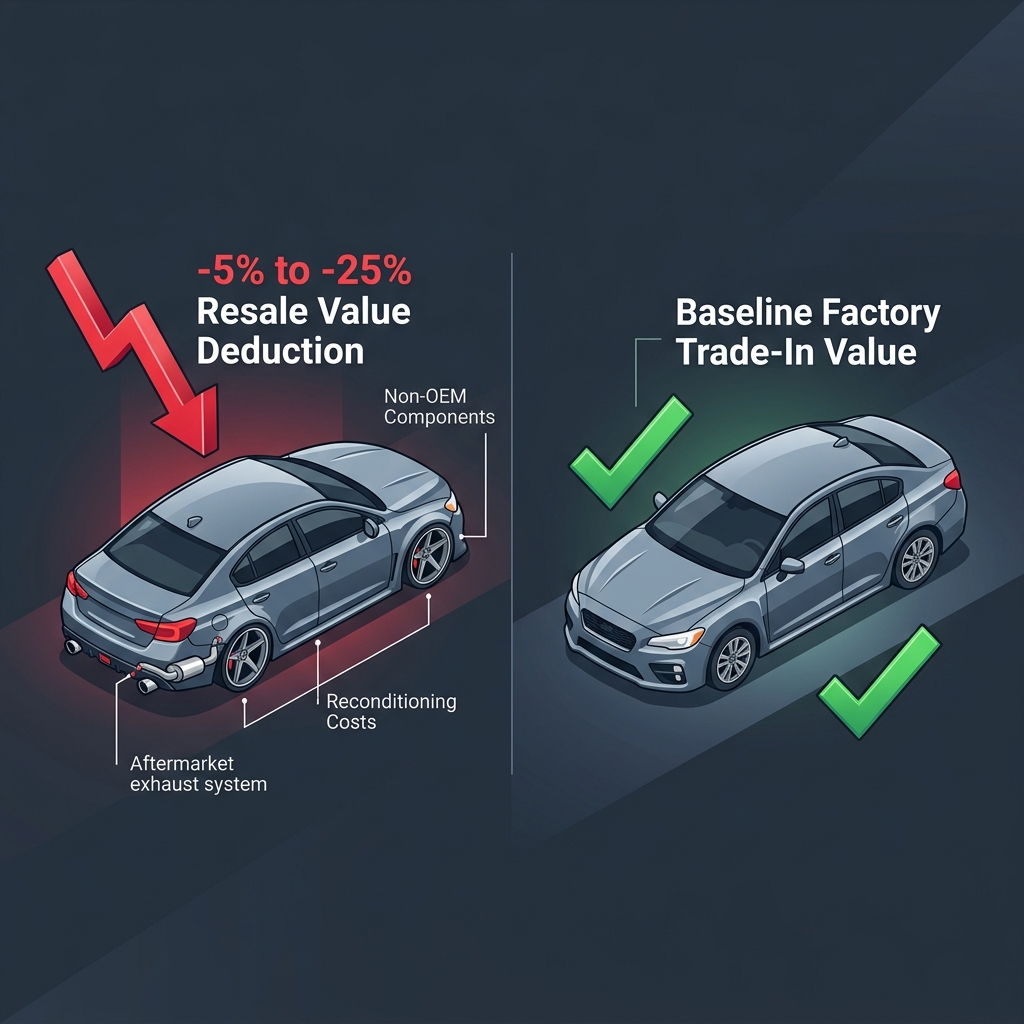
Aftermarket modifications generally reduce a car’s overall resale and trade-in value, as standard valuation guides and dealer appraisal algorithms calculate vehicle prices based on stock factory configurations. While a few practical or OEM-style accessories may maintain neutral value, non-factory mechanical, suspension, and cosmetic changes limit the buyer pool and usually require costly reconditioning to return the vehicle to original specifications.
Standard valuation books, such as Kelley Blue Book and Black Book, build baseline values around original equipment specifications. When an appraiser evaluates a vehicle, custom additions like oversized wheels or custom paint rarely add line-item credit to the appraisal value. In fact, an aftermarket wheel or exhaust package may add little or no value to the official wholesale calculation.
Vehicle appraisers deduct value for aftermarket components because pre-owned buyers overwhelmingly prefer unmodified cars that retain their factory durability, predictable ride quality, and original warranty coverage. When a vehicle features extensive non-factory alterations, our appraisal team must calculate the labor and parts cost required to restore the car to stock condition before offering it for resale. If you have questions about how non-factory components impact your current ride, you can visit our Boardman showroom or give us a call directly at (330) 427-3656 to speak with an appraisal specialist.
| Modification Category | Average Cost Recovery | Typical Dealer Appraisal Impact | Primary Value Driver / Concern |
|---|---|---|---|
| Bolt-On Performance Parts | 50% to 70% | 15% to 25% Reduction | Concerns over engine stress and warranty validity |
| Suspension Lift / Lowering | 40% to 60% | 5% to 20% Reduction | Ride comfort, chassis alignment, and tire wear |
| Cosmetic Wraps & Body Kits | 30% to 50% | 20% to 40% Reduction | Hidden body damage and labor costs to remove |
| Engine Swaps & Custom Turbo Kits | 20% to 40% | 25% or Greater Penalty | High risk of mechanical instability and loan denial |
| OEM-Style Practical Upgrades | 70% to 90% | Neutral to +10% | Broad buyer appeal and enhanced utility |
Table of Contents
- How Much Money Spent on Aftermarket Modifications Is Recovered at Resale?
- Do Exhausts, Lift Kits, and Audio Upgrades Increase Dealer Trade-In Value?
- How Do Wraps, Heavy Tint, and Body Kits Impact Vehicle Valuations?
- Common Questions About Selling and Trading Modified Vehicles in Boardman Township
- How to Get an Exact Cash Offer for Your Vehicle
How Much Money Spent on Aftermarket Modifications Is Recovered at Resale?
Vehicle owners typically recover 0% of modification costs during standard dealer trade-in appraisals and only 30% to 70% in private-party enthusiast sales, provided full documentation and receipts are preserved. Standard appraisal software treats non-OEM parts as zero-value additions or active deductions.
In private enthusiast markets, specific upgrades retain partial value if the buyer happens to seek that exact configuration. Performance bolt-ons like cold-air intakes or upgraded intercoolers might return 50% to 70% of their initial part price. Suspension components, including lowering springs or coilovers, generally yield 40% to 60% of part costs. Cosmetic changes yield even less, returning roughly 30% to 50% of the invested capital. Major structural modifications or custom engine swaps land at the bottom, recovering just 20% to 40% of installation expenses.
The financial gap between what an owner spends on modifications and what the market pays is often called the customization discount. When shoppers browse a used vehicle inventory, the vast majority look for unassisted reliability, intact factory safety features, and uncompromised fuel economy. Custom parts introduce buyer uncertainty regarding installation quality, component wear, and future maintenance costs.
- Receipts and Maintenance History: Comprehensive records showing professional installation can boost private resale value by 10% to 15% over undocumented builds.
- Dyno Tuning Sheets: Verified output charts confirm that engine tunes operate within safe mechanical tolerances.
- Reversibility Factor: Upgrades that unbolt cleanly allow you to reinstall factory parts, maximizing your eventual trade-in offer.
Do Exhausts, Lift Kits, and Audio Upgrades Increase Dealer Trade-In Value?
Common modifications like aftermarket exhausts, custom suspension lift kits, and high-wattage audio systems generally do not increase a dealer trade-in appraisal, and they frequently result in value penalties ranging from 5% to 20%. Appraisers view loud exhausts and altered ride heights as indicators of aggressive driving, increased chassis wear, or potential powertrain reliability risks.
When evaluating a trade-in, dealerships look at the broad appeal of the vehicle. A truck fitted with an aggressive suspension lift kit might appeal to a narrow segment of off-road enthusiasts, but it alienates mainstream commuters who prioritize easy entry, factory ride compliance, and standard fuel efficiency ratings. Additionally, heavy lift kits alter suspension geometry and accelerate wear on ball joints, CV axles, and universal joints, forcing the appraiser to factor potential repair costs into the offer.
Custom exhaust systems frequently remove factory catalytic converters or mufflers, creating cabin drone and potentially triggering check engine lights that fail state emissions checks. High-power aftermarket audio systems pose similar challenges; intrusive wiring harnesses, spliced factory looms, and modified door panels raise red flags during electrical system inspections. To check how your vehicle’s current condition translates to market value, you can value your trade-in online using our straightforward appraisal tool.
When drivers commute along the hilly terrain near Youngstown, altered suspension setups and noisy exhausts can spoil everyday cabin comfort. Stock vehicles retain stronger demand across regional pre-owned markets, making unmodified cars much easier to recondition, finance, and resell quickly.
How Do Wraps, Heavy Tint, and Body Kits Impact Vehicle Valuations?
Aesthetic cosmetic modifications—including full vinyl wraps, heavy window tinting, neon underglow, and custom body kits—typically reduce trade-in values by 20% to 40% compared to an identical stock vehicle. Appraisers flag these visual alterations as high-risk additions because peeling wraps, dark film, and fiberglass ground effects often hide underlying body damage or require expensive labor to remove.
Vinyl wraps degrade over time when exposed to winter road salt, ultraviolet rays, and drastic temperature shifts. When a wrapped vehicle arrives for evaluation, an appraiser cannot inspect the underlying clear coat or paint condition without removing the film. Because removing aged vinyl can take hours of manual labor—and risks pulling off loose paint or clear coat underneath—the dealer must deduct those potential labor costs from the trade-in offer.
Extreme window tint that exceeds legal light-transmittance limits must be peeled off before a vehicle can be placed on a retail lot. Similarly, aftermarket fiberglass body kits and lowered front splitters are prone to scraping on driveway aprons and parking curbs. Poor fitment, uneven panel gaps, and cracked fiberglass significantly reduce curb appeal and drive up reconditioning budgets.
- Paint Protection Film vs. Custom Wraps: Clear protective film applied over factory paint preserves exterior finish without altering vehicle appearance, supporting higher appraisal scores.
- Window Tint Compliance: Dark tint that complies with state visual light transmission standards avoids automatic removal deductions.
- Body Kit Fasteners: Body kits secured via drilled quarter panels or bumper covers permanently ruin underlying sheet metal, forcing full panel replacements.
Common Questions About Selling and Trading Modified Vehicles in Boardman Township
Trading or selling a modified vehicle requires knowing how non-factory parts impact valuation software and dealer reconditioning budgets. Below are answers to the questions local car owners ask most when evaluating custom upgrades prior to sale.
Q: Does keeping original factory parts improve trade-in value?
Yes, retaining original factory parts significantly improves trade-in outcomes. Reinstalling stock wheels, standard exhaust pipes, and factory air boxes before bringing your vehicle to an appraisal eliminates dealer reconditioning deductions. If you cannot swap the components yourself, presenting undamaged OEM parts alongside the vehicle allows the appraisal team to calculate a much smaller labor fee to return the car to stock.
Q: How does an ECU engine tune affect dealer appraisal offers?
An aftermarket ECU engine tune typically reduces trade-in value by 15% to 25% and may cause outright appraisal rejection if it voids manufacturer powertrain coverage. Dealers and lenders view non-factory engine software as a major durability risk that increases engine knock, transmission stress, and emissions compliance failures. Flashing the engine computer back to factory stock settings before an appraisal is essential for protecting your trade-in equity.
Q: Can documented service records offset value loss from aftermarket parts?
Detailed maintenance records help cushion the value loss caused by non-factory parts, but they rarely eliminate deductions entirely. Complete receipts proving regular oil changes, fluid flushes, and professional installation show that the owner cared for the vehicle. While thorough records build buyer confidence in private sales, dealer appraisal tools still calculate trade-in offers based on the physical cost of restoring the car to stock retail condition.
Q: Are any aftermarket modifications considered value-neutral?
A few practical, high-quality upgrades are considered value-neutral or slightly positive during appraisals. All-weather floor liners, OEM-style trailer hitches, integrated remote engine starters, and factory-option alloy wheels maintain baseline values because they add utility without altering mechanical reliability. These functional additions appeal broadly to second-hand buyers and do not require removal or reconditioning.
Q: What is the fastest way to find out what a modified car is worth?
The fastest way to determine your car’s true trade-in equity is to schedule a professional, hands-on appraisal. While online valuation tools offer a baseline, they cannot account for non-factory equipment or physical condition. Bringing your vehicle to an expert appraiser provides an exact, real-time cash offer based on current regional market demand.
For additional answers regarding vehicle purchasing, valuation guidelines, or sales requirements, feel free to visit our physical location, call our desk at (330) 427-3656, or explore our online frequently asked questions page.
How to Get an Exact Cash Offer for Your Vehicle
Unlocking the true equity in your current ride starts with a transparent, data-backed inspection. Whether your vehicle is completely stock or fitted with aftermarket accessories, accurate market valuations require an in-person assessment by experienced buyers who understand local market demand across Boardman Township.
Our buying team provides clear, straightforward appraisals without high-pressure sales tactics. We evaluate every vehicle on its individual merit, factoring in mileage, maintenance history, overall mechanical condition, and exterior presentation to deliver a competitive cash offer on the spot.
If you are ready to sell or trade your car, bring your title, service records, and any original factory components to our buying center. Stop by today or contact our team to receive a fast, fair valuation and see how simple selling your car can be.
© 2026 Ken Ganley Buying Center Boardman. All rights reserved.
While every effort has been made to ensure the accuracy of the information displayed on this website, the vehicle values, offers, and listings shown may not reflect all accurate vehicle details or current market conditions. Vehicle photos may be representative only and may not match the actual vehicle. All offers, appraisals, and transactions are subject to vehicle inspection, verification, and prior sale. Final purchase amounts may vary based on condition, equipment, history, and market factors. Please contact the Dealership for complete details and confirmation.