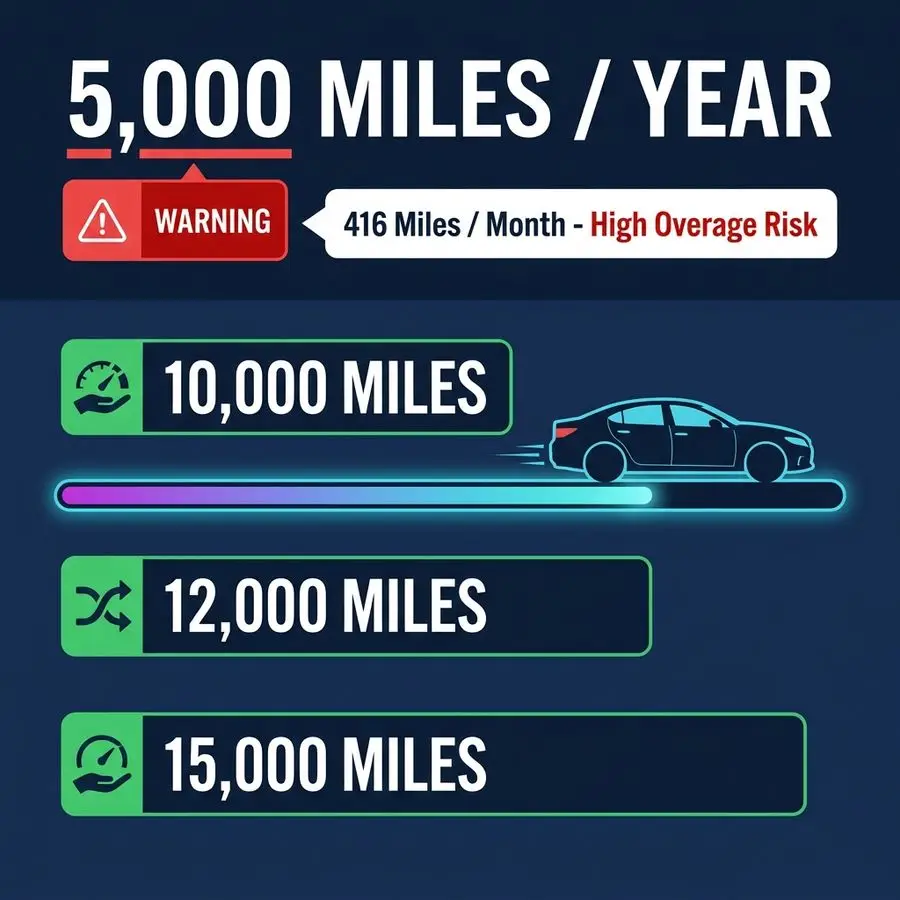
Most drivers should avoid signing a 5,000-mile annual lease because a limit of 5,000 miles per year allows just 416 miles per month, an allotment easily exceeded by simple daily driving and local errands. Exceeding this strict cap triggers per-mile overage fees at contract turn-in, which quickly wipes out the potential differences in monthly payments.
When evaluating lease agreements, ultra-low mileage limits look enticing on paper because lower mileage projections preserve higher residual values, resulting in potentially lower monthly payments. Standard industry terms typically grant 10,000-mile, 12,000-mile, or 15,000-mile allowances per year. Cutting that mileage allotment in half leaves virtually no buffer for unexpected trips, weekend outings, or routine changes in daily schedules.
At Ken Ganley Buying Center Boardman, we believe in complete clarity so you never face financial surprises when returning a vehicle or structuring a contract. If you want to discuss vehicle acquisition options or evaluate your current trade-in, stop by our Boardman showroom location or give our team a quick call to explore flexible purchasing paths tailored to your driving habits.
Table of Contents
- What Is a 5,000-Mile Lease and How Few Miles Is That Per Month?
- What Happens If You Go Over the Mileage Limit on a Lease?
- What Is the Average Cost Per Mile for Over-Mileage Penalties?
- Who Is an Ultra-Low-Mileage Lease Suited for and Can You Negotiate Higher Limits?
- How Do You Choose the Right Mileage Limit Before Signing?
- Common Questions About Auto Leases and Mileage Limits
- Next Steps to Find the Right Vehicle and Agreement in Boardman
What Is a 5,000-Mile Lease and How Few Miles Is That Per Month?
A 5,000-mile lease is an ultra-low-mileage contract that limits driving to exactly 5,000 miles per year, which breaks down to roughly 416 miles per month or about 13 miles per day.
To put that daily boundary in perspective, a simple round-trip drive of 14 miles each day will exceed the annual limit before the end of the 12-month period. Typical driver statistics across the country show average annual travel falling between 10,000 miles and 15,000 miles, making a 5,000-mile cap less than half of what a standard household consumes.
For a driver commuting through Boardman Township, routine trips between home, local retail hubs along the main strip, and surrounding family activities quickly accumulate 10 to 15 miles a day without factoring in out-of-town travel. On a three-year contract, a 5,000-mile annual cap permits only 15,000 miles in total, compared to 30,000 miles on a conventional 10,000-mile structure.
If your driving requirements vary or if you prefer total freedom from strict mileage accounting, purchasing or financing a quality vehicle provides ownership clarity with zero overage penalties.
What Happens If You Go Over the Mileage Limit on a Lease?
Exceeding your lease mileage allowance results in an excess mileage fee calculated for every mile driven over the contracted limit, which is billed directly as a lump-sum penalty when the vehicle is returned.
When you hand back a leased vehicle, the finance company compares the odometer reading to the total allowed mileage specified in your agreement. If you signed a three-year lease with a 5,000-mile annual limit ( 15,000 total miles) and return the vehicle with 21,000 miles on the odometer, you are responsible for 6,000 excess miles.
Conversely, if you drive significantly fewer miles than your contract allows, the finance company does not offer refunds or credits for unused mileage. The agreed allowance acts as a maximum ceiling rather than a flexible balance. In scenarios where a leased vehicle has accumulated substantial excess mileage, trading the vehicle in early or buying out the contract can sometimes mitigate hand-back fees by leveraging equity, though understanding market value variations is essential before deciding on a lease-end strategy.
What Is the Average Cost Per Mile for Over-Mileage Penalties?
Over-mileage penalty rates across major automotive lenders typically range from $0.15 per mile to $0.30 per mile, depending on the brand tier and specific contract structure.
Mainstream captive finance institutions—such as Toyota Financial Services, Honda Financial Services, and Ford Credit—generally set standard overage charges at $0.15 per mile. In contrast, luxury finance entities including BMW Financial Services, Mercedes-Benz Financial, Audi Financial Services, Porsche Financial Services, and Tesla assess charges in the higher $0.25 per mile to $0.30 per mile bracket.
Certain lenders also apply tiered penalty structures. Nissan Motor Acceptance Company assesses a $0.15 per mile fee on standard 12,000-mile to 15,000-mile annual agreements, but increases the rate up to $0.25 per mile on lower annual mileage contracts like 5,000 to 10,000 miles. Over a three-year term, exceeding a 5,000-mile limit by just 3,000 miles overall generates an extra charge between $450 and $900, while a 9,000-mile overage produces an unexpected bill ranging from $1,350 to $2,700 at turn-in.
Who Is an Ultra-Low-Mileage Lease Suited for and Can You Negotiate Higher Limits?
An ultra-low-mileage lease is primarily designed for remote workers, city residents with minimal driving needs, retirees, or households using the vehicle as a secondary runabout.
When local drivers ask whether an ultra-low-mileage agreement makes financial sense, we walk through their monthly mileage logs before discussing vehicle options. For urban commuters taking quick trips around Youngstown near educational institutions or downtown business centers, annual mileage may stay naturally low. However, even minor life changes—such as a new workplace location or extra weekend road trips—can rapidly push odometer readings past a strict 5,000-mile boundary.
Borrowers can usually negotiate higher annual mileage allowances before signing the initial contract. Buying additional mileage upfront—such as expanding from a 5,000-mile cap to a 10,000-mile tier—slightly increases the monthly payment by adjusting the residual value, but purchasing miles at contract inception is significantly less expensive than paying per-mile penalties at hand-back.
How Do You Choose the Right Mileage Limit Before Signing?
Choosing the right mileage limit requires auditing your actual historical driving records, estimating future travel demands, and adding a safety cushion to prevent unexpected overage fees.
To establish an accurate baseline, calculate your mandatory routine driving first. Multiply your round-trip commute distance by the workdays you drive each week, factoring in vacation time. Next, estimate annual personal driving, including routine errands, family visits, and seasonal trips. Checking prior vehicle service records or inspection reports provides an exact historical average rather than a rough estimate.
After calculating your projected annual total, add a 10% to 15% buffer to accommodate unexpected lifestyle shifts, route changes, or unplanned road trips. Finally, select the standard agreement tier—such as 10,000 miles, 12,000 miles, or 15,000 miles per year—that meets or slightly exceeds your buffered figure. Choosing a slightly higher tier upfront costs a fraction of end-of-lease penalty fees and provides complete driving peace of mind.
Common Questions About Auto Leases and Mileage Limits
Q: Are unused miles refunded when returning a leased vehicle?
Unused mileage is non-refundable at the end of a lease agreement. If you contract for 12,000 miles per year and return the vehicle having driven only 8,000 miles annually, the finance company retains the pre-calculated residual value structure and does not issue credits or checks for the unused portion.
Q: Is it cheaper to choose a lower mileage cap and pay overage fees later?
Paying overage fees at lease-end is almost always more expensive than selecting a higher mileage tier upfront. Pre-purchasing miles during contract structuring reduces the vehicle’s projected residual value incrementally, whereas end-of-lease penalty rates of $0.15 to $0.30 per mile carry a steep premium designed to cover unpredicted depreciation.
Q: How do finance companies track mileage when a lease ends?
Odometer readings are officially recorded during the vehicle’s turn-in condition inspection at contract termination. The total miles recorded are compared directly against the total permitted miles outlined in the original agreement (annual allowance multiplied by term length) to calculate whether an excess balance is owed.
Q: What options exist if you face heavy mileage penalties at lease-end?
Drivers facing heavy overage fees can explore buying out the vehicle at the contractually specified residual price, which eliminates mileage penalties entirely. Alternatively, trading the vehicle toward another purchase or consulting frequently asked questions about trade-in equity can help offset hand-back liabilities. If you have questions about your vehicle’s value, visit our Boardman center or give us a direct call.
Next Steps to Find the Right Vehicle and Agreement in Boardman
Selecting the appropriate mileage allowance is one of the most critical decisions when structuring a vehicle agreement. While a 5,000-mile annual cap promises lower monthly payments, the strict 416 miles per month boundary creates significant risk for expensive overage charges at hand-back. Most drivers achieve better long-term financial predictability by selecting standard 10,000-mile or 12,000-mile tiers, or by choosing traditional vehicle ownership financing.
At Ken Ganley Buying Center Boardman, our team is committed to providing transparent guidance and clear options whether you are trading in an existing vehicle, exploring pre-owned inventory, or evaluating finance structures. Visit our team today to discuss your driving habits and receive a personalized quote tailored to your budget and daily travel needs.
© 2026 Ken Ganley Buying Center Boardman. All rights reserved.
While every effort has been made to ensure the accuracy of the information displayed on this website, the vehicle values, offers, and listings shown may not reflect all accurate vehicle details or current market conditions. Vehicle photos may be representative only and may not match the actual vehicle. All offers, appraisals, and transactions are subject to vehicle inspection, verification, and prior sale. Final purchase amounts may vary based on condition, equipment, history, and market factors. Please contact the Dealership for complete details and confirmation.